

Why VTOL UAVs Are Changing the Way Long-Endurance Missions Are Done
Why VTOL UAVs Are Changing the Way Long-Endurance Missions Are Done
For decades, there has been a fairly simple trade-off in unmanned aircraft.
If you wanted endurance and range, you generally looked towards fixed-wing aircraft.
If you wanted simple deployment and the ability to take off and land almost anywhere, you looked towards multirotors.
Then came the hybrid VTOL UAV.
By combining vertical take-off and landing with fixed-wing flight, engineers can bring together two very different characteristics in one aircraft.
And that creates some interesting possibilities.
The problem with traditional fixed-wing UAVs
Fixed-wing aircraft are extremely efficient once they are flying.
The wings generate lift as the aircraft moves forward, meaning the propulsion system doesn't have to continuously provide all of the lift required to keep the aircraft airborne.
This is one of the reasons fixed-wing UAVs are well suited to missions such as mapping, surveying, long-distance inspection and surveillance.
But they have a problem:
They need somewhere to take off and land.
Depending on the aircraft, this might mean a runway, launch rail, catapult, hand launch or another recovery system.
That isn't always practical.
Imagine operating from a remote mine, a large agricultural property, a construction site, a forest or an area with limited infrastructure.
You may have plenty of airspace.
You may have a very good mission.
But you may not have a runway.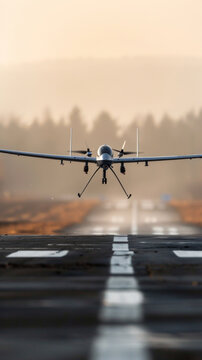
Then there is the multirotor
Multirotors solved the launch problem beautifully.
They can take off vertically.
They can hover.
They can land vertically.
They can operate from relatively confined spaces.
But hovering is energetically expensive.
A multirotor must continuously produce thrust to support its own weight. This makes long-duration flight considerably more challenging than efficient fixed-wing cruise.
That is where VTOL fixed-wing aircraft become interesting.
The Best of Two Flight Modes

A VTOL fixed-wing UAV can use vertical lift for take-off and landing and then transition into wing-borne forward flight.
The aircraft essentially changes how it flies depending on which part of the mission it is performing.
During take-off:
Vertical flight.
During cruise:
Fixed-wing flight.
During recovery:
Vertical flight again.
The result is an aircraft that doesn't necessarily need a runway while still benefiting from the efficiency of a wing during the majority of its mission.
Research into VTOL fixed-wing configurations highlights this exact trade-off: vertical flight provides operational flexibility, while fixed-wing cruise provides the efficiency required for longer-distance missions.
But VTOL isn't a magic solution
There is an important engineering compromise.
The vertical lift system adds weight, drag and energy requirements.
The aircraft therefore has to be designed carefully.
Every motor, propeller, battery, structural component and payload affects the overall aircraft.
This is why designing a VTOL UAV isn't simply a matter of putting four motors onto a fixed-wing aircraft.
The entire aircraft needs to work as a system.
This is where mission requirements matter
A UAV intended to fly for 30 minutes over a small site has very different requirements from one expected to spend several hours monitoring a large area.
The right question isn't:
“Which UAV is the best?”
The better question is:
“Which UAV architecture makes the most sense for this mission?”
That's the approach we take at BlackBox UAV.
The mission comes first.
The aircraft comes second.
And sometimes, the aircraft required for the mission doesn't exist yet.
That's where engineering gets interesting.
BlackBox UAV — When off-the-shelf isn't enough.